Implementing Container Runtime Shim: runc

A container runtime shim is a piece of software that resides in between a container manager (containerd, cri-o, podman) and a container runtime (runc, crun) solving the integration problem of these counterparts.
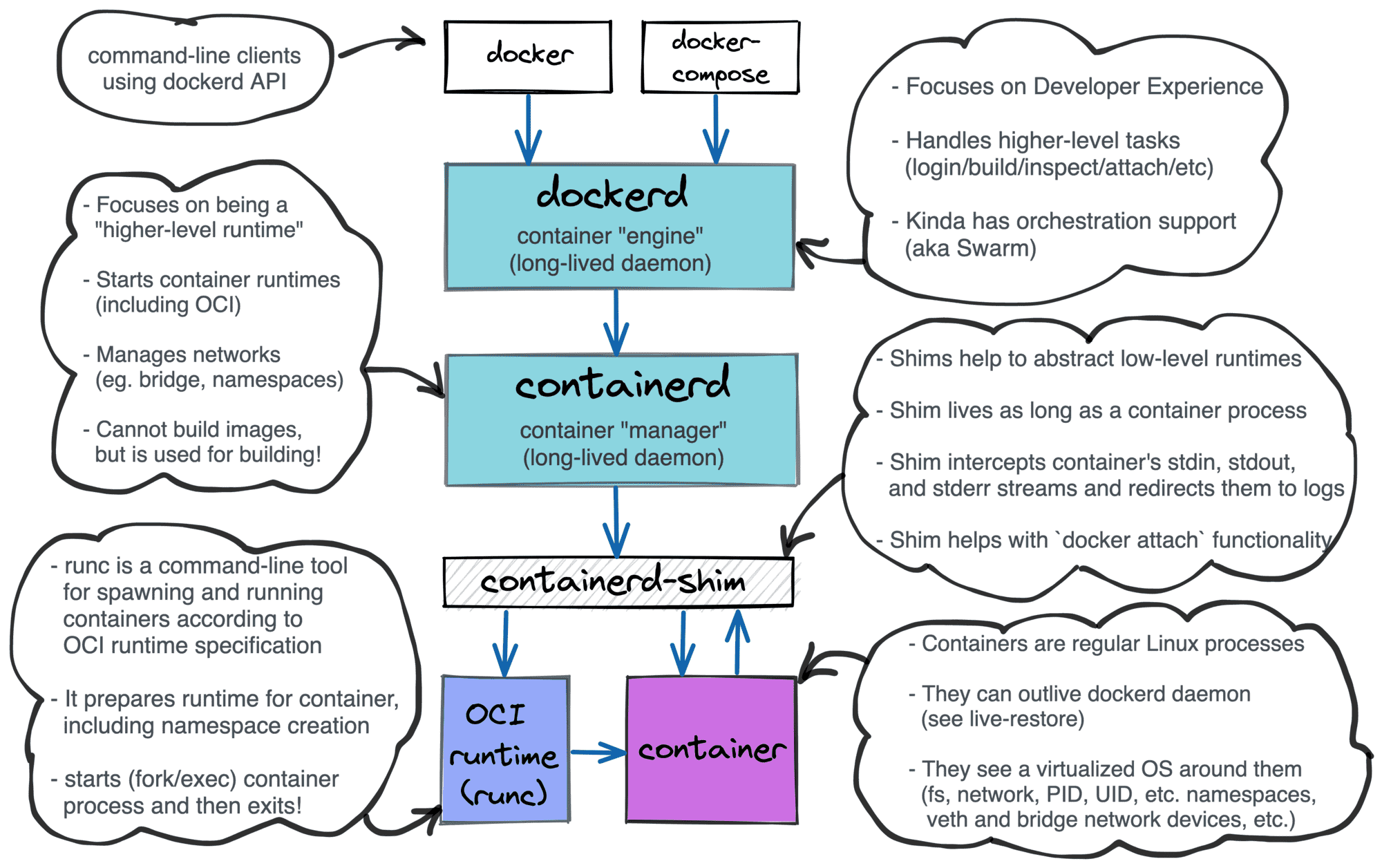

Layered Docker architecture: docker (cli) -> dockerd -> containerd -> containerd-shim -> runc

Layered Docker architecture

The easiest way to spot a shim is to inspect the process tree on a Linux host with a running docker container:

Spotting container runtime shim process

ps auxf output on a host running docker run -it ubuntu bash; notice containerd-shim process in between containerd and bash.

On the one hand, runtimes need shims to be able to survive managers restarts. On the other hand, shims are helping container managers to deal with the quirky behavior of runtimes. As a part of the container manager implementation series, we will try to create our own shim and then integrate it with conman, an experimental container manager. Hopefully, during the development, we will gain an in-depth understanding of the topic.

However, before jumping to the shim development, we need to familiarize ourselves with the container runtime component of the choice. Unsurprisingly, conman uses runc as a container runtime, so I will start the article by covering basic runc use cases alongside its design quirks. Then I'll show the naive way to use runc from code and explain some related pitfalls. The final part of the article will provide an overview of the shim's design.

Read more

Kubernetes Repository On Flame

When I'm diving into a new codebase, I always start from the project structure analysis. And my favorite tool is tree. However, not every project is perfectly balanced. Some files and folders tend to be more popular and contain much more code than others. Seems like yet another incarnation of the Pareto principle.

So, when the tree's capabilities aren't enough, I jump to cloc. This tool is much more powerful and can show nice textual statistics for the number of code lines and programming languages used per the whole project or per each file individually.

However, some projects are really huge and some lovely visualization would be truly helpful! And here the FlameGraph goes! What if we feed the cloc's output for the Kubernetes codebase to FlameGraph? Thanks to the author of this article for the original cloc-to-flamegraph one-liner:

git clone https://github.com/brendangregg/FlameGraph
go get -d github.com/kubernetes/kubernetes

cd $(go env GOPATH)/src/github.com/kubernetes/kubernetes

cloc --csv-delimiter="$(printf '\t')" --by-file --quiet --csv . | \
    sed '1,2d' | \
    cut -f 2,5 | \
    sed 's/\//;/g' | \
    ~/FlameGraph/flamegraph.pl \
        --width=3600 \
        --height=32 \
        --fontsize=8 \
        --countname=lines \
        --nametype=package \
    > kubernetes.html

open kubernetes.html

Read more

conman - [the] Container Manager: Inception

With this article, I want to start a series about the implementation of a container manager. What the heck is a container manager? Some prominent examples would be containerd, cri-o, dockerd, and podman. People here and there keep calling them container runtimes, but I would like to reserve the term runtime for a lower-level thingy - the OCI runtime (de facto runc), and a higher-level component controlling multiple such runtime instances I'd like to call a container manager. In general, by a container manager, I mean a piece of software doing a complete container lifecycle management on a single host. In the following series, I will try to guide you myself through the challenge of the creation of yet another container manager. By no means, the implementation is going to be feature-complete, correct or safe to use. The goal is rather to prove the already proven concept. So, mostly for the sake of fun, let the show begin!

Read more

Journey From Containerization To Orchestration And Beyond

Containers gave birth to more advanced server-side architectures and sophisticated deployment techniques. Containers nowadays are so widespread that there is already a bunch of standard-alike specifications (1, 2, 3, 4, ...) describing different aspects of the containers universe. Of course, on the lowest level lie Linux primitives such as namespaces and cgroups. But containerization software is already so massive that it would be barely possible to implement it without its own concern separation layers. What I'm trying to achieve in this ongoing effort is to guide myself starting from the lowest layers to the topmost ones, having as much practice (code, installation, configuration, integration, etc) and, of course, fun as possible. The content of this page is going to be changing over time, reflecting my understanding of the topic.

Read more